• SA Covid19 Resources & News Portal
  • Need help? Call our 24-hour Helpline:
  • 021 447 9762
  • DONATE TODAY
Rape Crisis
  • Get Help
  • Our Work
    • Programmes
      • Road to Recovery
      • Making Change
      • Road to Justice
    • Our Campaigns
      • RSJC
  • Who We Are
  • Get Involved
  • News & Resources
    • News
    • Toolkits
    • Reports
  • Contact us
  • Menu Menu

Understanding Victim Blaming

GBV / Gender based violence, Making Change, Speak Out

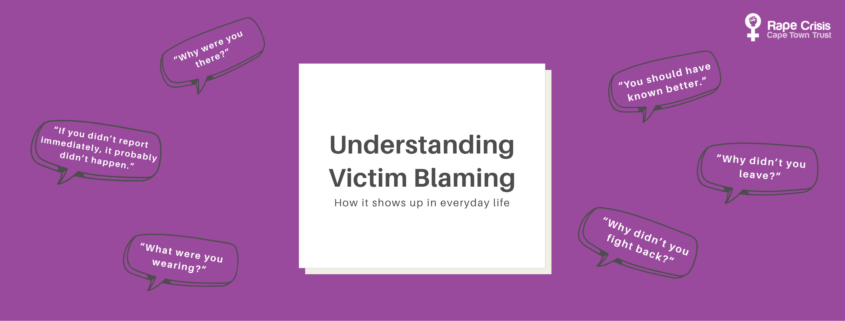
Victim blaming happens when attention is shifted away from the person who caused violence and placed instead on the survivor of sexual violence. It is one of the most common and deeply embedded responses to sexual violence, often so normalised that it becomes almost invisible in everyday life.

It rarely appears in obvious or direct ways. More often, it is found in the language people use, the assumptions they make, and the way they respond to disclosures. It can come from shock, curiosity, discomfort, or a desire to understand what happened, but the impact remains harmful.

Instead of focusing on the person responsible for the harm, conversations often turn toward the survivor’s actions, choices, or behaviour. Whether it is questioning why someone did not report immediately, what they were wearing, where they were, or how they responded, the effect is the same, responsibility is subtly shifted away from the perpetrator.

Because these ideas are so deeply embedded in society, they are often repeated without reflection. They can appear in conversations with friends and family, in community responses, and even within systems meant to offer care and protection. In these moments, survivors may find themselves met with doubt or judgement at the very point they need support most.

The impact can be profound. Survivors may experience shame, self-blame, confusion, fear, or a deep sense of isolation. Many begin to question whether they will be believed or whether speaking out will only lead to further harm. For some, this becomes a barrier to seeking help at all.

Sexual violence is never caused by what someone was wearing, where they were, who they trusted, or how quickly they responded afterwards. The responsibility always lies with the person who chose to cause harm.

Recognising victim blaming means noticing how easily it surfaces in everyday conversations and choosing to respond differently. Instead of questioning survivors, we listen. Instead of searching for fault, we offer belief, care, and support.

If you can’t speak to anyone, speak to us:

English: 021 447 9762

isiXhosa: 021 361 9085

Afrikaans: 021 633 9229

WhatsApp (weekdays): 083 222 5164


Written by

Jameelah Ebrahim

9th July 2026/by Sino
https://rapecrisis.org.za/wp-content/uploads/2026/07/Blog-Header.png 803 2113 Sino https://rapecrisis.org.za/wp-content/uploads/2020/10/RC-logo-color-1.png Sino2026-07-09 17:17:212026-07-09 17:18:21Understanding Victim Blaming

Spotlight on Barbara Fortuin

Counselling, Feminism, GBV / Gender based violence, Speak Out

More than 19 Years of Leadership, Care and Commitment Behind the Work

At Rape Crisis, supporting survivors happens across many spaces from counselling rooms and court support, to advocacy and community work. It also happens behind the scenes, in the steady coordination, decision making, and care that ensure these services are able to function every day. Barbara Fortuin, our Programmes Manager, plays a central role in holding this work together.

Her role focuses on the smooth running and implementation of all our programmes. No two days look the same. While some aspects are planned, much of her day is spent responding to what arises, managing competing priorities, and ensuring that both staff and survivors are supported in real time.

Barbara’s journey at Rape Crisis began in 2006 when she graduated as a volunteer counsellor. She spent the early years of her work providing direct support to survivors before stepping into the role of Counselling Coordinator in 2009, a position she held for more than eleven years.

“That was probably the most amazing part of my journey,” she reflects. “I was completely invested in the growth of both clients and the team of women providing the counselling.”

In 2021, she stepped into the role of Operations Manager, now known as Programmes Manager, where she continues to shape the organisation at a management level. This year marks more than 19 years of her being part of Rape Crisis.

What has kept her here is a deep connection to the organisation’s values of growth, purpose, healing, and unity. These values continue to guide how she approaches her work and how she shows up for both survivors and her team.

For Barbara, survivor centered care is about recognising that the focus is always on the survivor’s journey. “It is about the journey of the survivor, not what I am doing or my role in it, but how I am able to show up in the way that the survivor needs,” she explains. “Everything we do should contribute to their safety, support, and dignity.”

Over the years, many moments have affirmed why this work matters. She speaks about the realities survivors face when they are not treated fairly, when young people struggle to break the silence, and when families and communities feel unsure how to respond. She also reflects on the dedication of those doing the work.

“When staff and volunteers put their own needs aside in the interest of survivors, that is when I know this work matters,” she says.

Working in a space that is constantly changing means learning how to navigate the unexpected. For Barbara, this comes down to self-containment and perspective. “Being able to contain things without letting them spill over helps a lot,” she shares. “I have also learned that it is okay to deal with one thing at a time.”

Teamwork and collaboration are central to how she leads. Grounded in the value of unity, she takes a strength based approach, recognising what each person brings and allowing those strengths to support the team as a whole.

“A supportive team is one where people feel safe enough to support and coach each other, where support is available and accessible, and where it meets the needs of the person asking for it,” she explains.

What she wishes people understood is that the impact of sexual violence does not end when the act itself ends. The effects can last for many years, which means the need for support continues long after.

“There will never be a more important time to support a survivor or the organisations working with survivors than right now,” she says.

She also reminds us that meaningful change often begins with small actions. Believing someone who discloses, offering support, or using your voice to raise awareness in your community can all make a difference.

After more than 19 years, Barbara’s journey reflects what it means to stay committed to the work, to grow within it, and to continue showing up with care and intention. While much of what she does happens behind the scenes, its impact is felt across every part of the organisation and in the lives of the survivors we support.

Thank you, Barbara, for your leadership, your steadiness, and your continued commitment to ensuring that survivors are supported with care, dignity, and respect every step of the way.


Written by

Jameelah Ebrahim

21st April 2026/by Sino
https://rapecrisis.org.za/wp-content/uploads/2026/04/Barbara-Blog-Header.png 321 845 Sino https://rapecrisis.org.za/wp-content/uploads/2020/10/RC-logo-color-1.png Sino2026-04-21 18:23:102026-04-21 18:23:54Spotlight on Barbara Fortuin

The Rape Culture Pyramid

Feminism, GBV / Gender based violence, Making Change, Speak Out

The Rape Culture Pyramid is a tool used to understand how sexual violence is sustained within society. It shows that violence does not exist in isolation. It is connected to everyday attitudes, behaviours, and systems that shape how we understand gender, power, and consent.

At the base of the pyramid is normalisation. This includes sexist attitudes, rape jokes, locker room banter, and language that minimises consent or questions survivors’ credibility. These messages are often dismissed as harmless, but they create an environment where entitlement to another person’s body can take root.

When harmful beliefs are normalised, they shape how communities respond when someone discloses violence.

In the middle of the pyramid are degrading and violating behaviours. Stealthing, contraceptive sabotage, unsolicited sexual images, stalking, groping, and the non consensual sharing of intimate images are not minor incidents.

They are serious violations of autonomy and dignity. Yet many survivors describe how these experiences were minimised, excused, or reframed as misunderstandings rather than recognised as abuse.

At the top of the pyramid are acts of sexual violence such as rape, drugging, and molestation. These acts do not emerge from nowhere. They exist within a broader culture that too often excuses coercion, manipulation, threats, and boundary violations.

For survivors, this is not an abstract framework. It reflects lived realities. Many speak about how warning signs were ignored, how degrading behaviour was normalised, or how their experiences were questioned.

The pyramid reminds us that prevention does not begin only after a crime has been committed. It begins with challenging harmful attitudes, confronting degrading behaviour, and refusing to tolerate violations at any level.

Combating sexual violence requires more than individual accountability. It requires cultural change. It requires shifting how we talk about consent, how we respond to disclosures, and how seriously we treat so called everyday behaviours that undermine dignity.

Survivors deserve more than reaction. They deserve a society committed to prevention, accountability, and respect at every level of the pyramid.

If you can’t speak to anyone, speak to us:

English (021 447-9762)

isiXhosa (021 361-9085)

Afrikaans (021 633-9229)

WhatsApp line (083 222-5164, weekdays)


Written by

Jameelah Ebrahim

16th March 2026/by Sino
https://rapecrisis.org.za/wp-content/uploads/2026/03/The-Rape-Culture-Pyramid.png 321 845 Sino https://rapecrisis.org.za/wp-content/uploads/2020/10/RC-logo-color-1.png Sino2026-03-16 23:59:282026-03-16 23:59:28The Rape Culture Pyramid

Rape Crisis Fundraising Event

Donate, GBV / Gender based violence, Get Involved, Making Change, Speak Out

Join Rape Crisis for a special screening of the acclaimed South African documentary Dorpie at an evening of insight, reflection and storytelling under the stars at Maynardville Park.

As our very first fundraiser, this event will be dedicated to raising awareness and strengthening community through the power of art in support of our mission to build safe houses, safe homes and safe communities. These are spaces where consent, care and compassion are the foundation of our shared humanity.

This evening will be more than a film screening – it’s an invitation to reflect on what safety means in the places we call home.

Through the documentary, an engaging panel discussion and a thought-provoking visual art installation titled Safe Houses, we’ll explore themes of consent, healing and empowerment. Together we’ll foster dialogue, promote healing and celebrate the resilience of survivors.

Expect a gentle yet powerful atmosphere filled with moving art, good food and opportunities to engage, learn and connect.

Date: Friday, 5th December 2025

Time:19:00pm – 22:00pm

Venue: Maynardville Park, Cape Town

Tickets: https://qkt.io/YNjvtc

Every voice matters, and every contribution helps – together we can turn compassion into action and art into advocacy. Your ticket supports Rape Crisis in our mission to support survivors, advocate for justice and nurture a culture of safety and consent in South Africa.

Let’s come together to celebrate the strength of survivors, the power of community and our shared vision of safe houses, safe homes and safe communities.

26th November 2025/by Sino
https://rapecrisis.org.za/wp-content/uploads/2025/11/Header_Fundraising-Film-Screening.png 500 1500 Sino https://rapecrisis.org.za/wp-content/uploads/2020/10/RC-logo-color-1.png Sino2025-11-26 21:52:092025-11-26 21:52:09Rape Crisis Fundraising Event

Holding Space for Healing

Counselling, GBV / Gender based violence, Road To Recovery, Speak Out
Edith’s Journey as a Volunteer Counsellor

For Edith Medell, being a volunteer counsellor at Rape Crisis is not just about listening. It is about holding space for stories that carry both immense pain and incredible strength. Every survivor she meets teaches her something new about courage, resilience, and the quiet power of healing.

“When someone sits across from you and shares what they have survived, you realise that healing is not a destination,” Edith says. “It is a journey made up of many small moments. Moments of truth, of vulnerability, and of courage.”

Edith has been a volunteer counsellor for several years, offering free, confidential support to survivors of sexual violence. She describes her role as one that demands both empathy and presence. “It is not about having all the answers,” she explains. “It is about being willing to listen, to see someone in their pain, and to remind them that they are not alone.”

One of the most powerful lessons she has learned in her time with Rape Crisis is that resilience is not just about bouncing back. It’s about bouncing forward, learning, growing, and rebuilding a sense of self even after deep harm. “Vulnerability sounds like truth and feels like courage,” Edith says. “It is never weakness.”

She has seen how survivors often doubt their strength, especially in a world that can be harsh and dismissive of their pain. “Finding your voice is a process,” she says. “A woman with a voice is a strong woman, but the search to find that voice can be remarkably difficult. Sometimes, we become the voice for the unspoken ones until they are ready to speak for themselves.”

For Edith, counselling is not only about emotional recovery. It is about restoring dignity and reminding survivors that they still have agency, worth, and power. “The counselling room becomes a space of rebuilding,” she explains. “You see people slowly start to believe in themselves again. You see them realise that what happened to them does not define who they are.”

Edith also believes that healing does not happen in isolation. It is a collective process that includes families, communities, and society at large. “When survivors heal, they begin to shift the energy around them. Their courage inspires others to confront silence, to speak up, and to build safer spaces for everyone.”

Every time she sees a survivor take one small step forward — whether it is coming to a second counselling session, sharing their story for the first time, or simply breathing a little easier — she feels a renewed purpose. “Healing is not just power,” Edith says. “It is hope.”

Her time at Rape Crisis has changed her deeply. It has shown her that compassion can be a form of resistance, and that showing up again and again with empathy and without judgement is one of the most radical things a person can do. “The work is hard,” she admits. “But every conversation reminds me that transformation is possible. Survivors teach me what real strength looks like. They remind me why I am here.”

For Edith, each session, each survivor, and each moment of connection is part of a larger story — one of rebuilding trust, nurturing healing, and restoring hope in a world that too often forgets how to care.


Written by

Jameelah Ebrahim

20th November 2025/by Sino
https://rapecrisis.org.za/wp-content/uploads/2025/11/Ediths-Blog-Cover.png 321 845 Sino https://rapecrisis.org.za/wp-content/uploads/2020/10/RC-logo-color-1.png Sino2025-11-20 20:08:142025-11-20 20:08:14Holding Space for Healing

A Letter from a Survivor

Counselling, Road To Justice, Road To Recovery, Speak Out

The following piece is a first-hand account of sexual abuse written by a courageous survivor in her own words. Parts of this letter may be triggering to some – reader discretion is advised. If you would like to speak to a Rape Crisis counsellor, please contact our 24 helpline: 021 447 9762. If you can’t speak to anyone, speak to us.

You have a choice. Don’t let anybody make you believe that you don’t.

Someone might have power over your body for a moment, but they don’t have power over your mind or your future. I know because a few months ago I thought it was going to be a normal Monday afternoon, but it was not a normal Monday.

I was raped for two hours that Monday. Someone that I had trusted with what was most important to me disregarded my trust in the most horrific way. I kept asking him to stop as the tears flooded my eyes and ran down my cheeks, but he did not stop.

He did not stop.

If it wasn’t for a phone call with a friend the day after, I don’t know if I would have said anything. But that evening I decided to press charges, and since then I have been fighting for my own justice. It was at the forensic unit that I visited within 72hrs that the fact that I had been raped finally hit me.

Though the inside of my secret place had been violently torn, broken, skinned, bruised, and swollen (I could not walk properly or sit down without pain for two weeks and the doctor said it would take 6-8 months for my body to heal completely) — these were only physical wounds. But it was the unseen wounds that I did not accept.

I did not accept shame, depression, feeling unloved, unworthy, rejected or broken. I did not accept the idea that I was any less of a person than I was before the rape. I did not accept that there was anything wrong with me, because there wasn’t. No, there was only something wrong with the person that committed this crime.

Though I still felt pain and my heart was broken because someone I considered a friend would do this to me, it was not the pain that tripped me up. NO, it was the pain that made me want to scream. It was the pain that made me want to speak. It was the pain that made me want to let the world know that even though evil things happen, you do NOT need to allow a circumstance to have power over you.

Even if you didn’t speak up when you were raped, you can still speak up now – it’s never too late to share your story.

You can still have your justice too.

29th April 2022/by Sino
https://rapecrisis.org.za/wp-content/uploads/2022/04/BLOG-POST-2-1.png 1400 1400 Sino https://rapecrisis.org.za/wp-content/uploads/2020/10/RC-logo-color-1.png Sino2022-04-29 11:39:052025-07-21 19:39:48A Letter from a Survivor

Storytelling: How the #SurvivorSeries was Born

Counselling, GBV / Gender based violence, Road To Recovery, Speak Out

April is Sexual Assault Awareness Month (SAAM). SAAM is observed to raise awareness and provide education about sexual assault prevention. For the 21st annual SAAM, we launched the #SurvivorSeries on our social media channels. The video series was created during what we dubbed our ‘Storytelling Circles’ – where survivors and members of our organisation got the opportunity to share their very personal survivor journeys.

Storytelling is central to our work at Rape Crisis. Everyday survivors invite us into their lives to walk their journeys of recovery and personhood in our counselling programme. The ‘Storytelling Circles’ were an expansion of that – a group setting of support and empowerment that nurtured a courageously unfiltered expression of the intricacies of the rape (and sexual violence) survivor journey. 

Three (3) beautiful women allowed us an unfettered look into their journeys. We allowed each storyteller to speak as freely as they pleased, and the result is an electrically unbridled video series that gets to the heart of the experiences of rape survivors in South Africa. The Circles were led by a storytelling coach, Philippa Namutebi Kabali-Kagwa, who highlights and unpacks the value of storytelling as a medium in the introduction video (that you can watch below).

The #SurvivorSeries is comprised of five (5) videos – including a courageous first-hand survivor account, a second-hand account of a rape survivor’s experience with the police, as well as a Rape Crisis Volunteer’s experiences touching the lives of survivors at our community workshops. What you will hear will be sensitive, sometimes challenging and may be triggering. The videos all have a trigger warning at the beginning – if what you hear does trigger you, please do not hesitate to contact our 24-hour counselling helpline 021 447-9762.


Overview – Phillippa on the power of storytelling


Kath – On the immeasurable value of storytelling at Rape Crisis 


Fumana – On what a family member did to her when she was 8 years old 


Nomvula – On how a Rape Crisis workshop helped a rape survivor with the police


Nosipho – On her journey touching the lives of rape survivors as a Rape Crisis workshop facilitator


Former Rape Crisis Director, Kath Dey: “At Rape Crisis we believe in the principle of empowerment. Rape essentially takes away a person’s power, and it takes away all choice and agency that they have in that particular moment. There are many things that are traumatic about rape, but that helplessness and inability to have any impact over what is happening is a very powerful part of it.

“Everything that we do at Rape Crisis is designed to undo that. And to renew the possibility of having power, of having choice, of having agency – of being able to have impact on your world and on your life.” 

The #SurvivorSeries was filmed by the Msizi Agency.


Written by 

Sino Mdunjeni 

Digital Officer

30th April 2021/by Sino
https://rapecrisis.org.za/wp-content/uploads/2020/10/RC-logo-color-1.png 0 0 Sino https://rapecrisis.org.za/wp-content/uploads/2020/10/RC-logo-color-1.png Sino2021-04-30 14:06:252021-04-30 14:06:25Storytelling: How the #SurvivorSeries was Born

News and Resources

  • Understanding Victim Blaming9th July 2026 - 5:17 pm
  • The Impact of Sexual Violence on Sleep and Memory29th June 2026 - 5:14 pm
  • Mandela Day Justice Pack Drive24th June 2026 - 9:33 pm
Popular
  • Understanding Victim Blaming9th July 2026 - 5:17 pm
  • Annual Report 20234th September 2023 - 4:08 pm
  • Post Rape Care
    Post Rape Care – Advocacy Toolkit29th November 2023 - 5:01 pm
Recent
  • Understanding Victim Blaming9th July 2026 - 5:17 pm
  • The Impact of Sexual Violence on Sleep and Memory29th June 2026 - 5:14 pm
  • Mandela Day Justice Pack Drive24th June 2026 - 9:33 pm
Comments

Send us an email

Email: communications@rapecrisis.org.za
Complaints: complaints@rapecrisis.org.za

Talk to us

  • Facebook
  • Twitter
  • Instagram
  • Youtube
  • Mail

Subscribe to our newsletter

© 2026 Rape Crisis - Cape Town Trust. All Rights Reserved. NPO 044-786
  • Privacy Policy
  • Terms of Service
  • Data Deletion Policy
Scroll to top Scroll to top Scroll to top

This site uses cookies. By continuing to browse the site, you are agreeing to our use of cookies.

OKLearn more

Cookie and Privacy Settings


How we use cookies

We may request cookies to be set on your device. We use cookies to let us know when you visit our websites, how you interact with us, to enrich your user experience, and to customize your relationship with our website.

Click on the different category headings to find out more. You can also change some of your preferences. Note that blocking some types of cookies may impact your experience on our websites and the services we are able to offer.

Essential Website Cookies

These cookies are strictly necessary to provide you with services available through our website and to use some of its features.

Because these cookies are strictly necessary to deliver the website, refusing them will have impact how our site functions. You always can block or delete cookies by changing your browser settings and force blocking all cookies on this website. But this will always prompt you to accept/refuse cookies when revisiting our site.

We fully respect if you want to refuse cookies but to avoid asking you again and again kindly allow us to store a cookie for that. You are free to opt out any time or opt in for other cookies to get a better experience. If you refuse cookies we will remove all set cookies in our domain.

We provide you with a list of stored cookies on your computer in our domain so you can check what we stored. Due to security reasons we are not able to show or modify cookies from other domains. You can check these in your browser security settings.

Google Analytics Cookies

These cookies collect information that is used either in aggregate form to help us understand how our website is being used or how effective our marketing campaigns are, or to help us customize our website and application for you in order to enhance your experience.

If you do not want that we track your visit to our site you can disable tracking in your browser here:

Other external services

We also use different external services like Google Webfonts, Google Maps, and external Video providers. Since these providers may collect personal data like your IP address we allow you to block them here. Please be aware that this might heavily reduce the functionality and appearance of our site. Changes will take effect once you reload the page.

Google Webfont Settings:

Google Map Settings:

Google reCaptcha Settings:

Vimeo and Youtube video embeds:

Other cookies

The following cookies are also needed - You can choose if you want to allow them:

Privacy Policy

You can read about our cookies and privacy settings in detail on our Privacy Policy Page.

Privacy Policy
Accept settingsHide notification only
Need help?